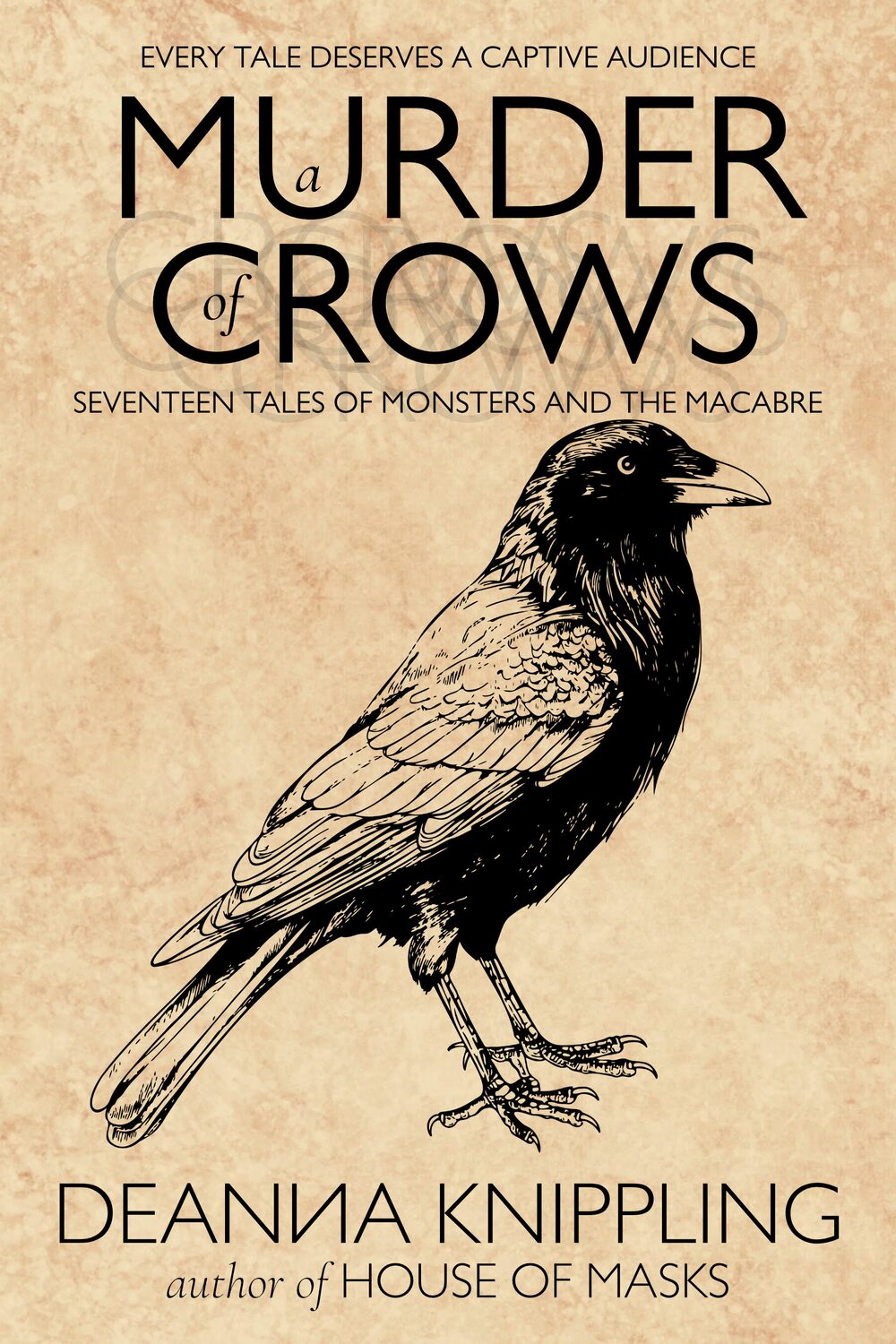
Description
Nobody guts—or comforts—readers in the same breath quite like DeAnna Knippling, veteran author of 80+ books.
Winter on the northern prairies kills lost souls quickly. So when a flock of crows steals a gangling, lost young girl from a farm, they see it more as borrowing than theft. They carry her to a stinking, crowded nest hidden amongst junked cars and dead refrigerators, wrap her in stolen wool against the blizzard, and give her the gift of something shinier than shiny: they tell her stories.
A priest hiding a murderer’s name behind his holy collar. A woman whose hunger no funeral feast can fill. Pigs that come for the man who once fed them. A seal who slips out of her own skin to search for her sister. Every story a monster, and every monster at least one crow’s favorite.
Every crow loves telling a story to a good listener. A good listener is a gift.
With her wide eyes and innocent ears, her gasps and laughter and tears, the crows’ little stolen girl is one of the best.
Surely no one could be so foolish as to try to take her away…
Cozy horror with the teeth still in: seventeen macabre, tender, merciless tales that wield the oldest magic of all—the story you tell against the dark.
“…like a hit of the good drugs.”
—Michael Warren Lucas, author of Laserblasted
Read a sample
It was we crows who took your daughter, in case you were wondering. She didn’t run away. We had—I had—been watching her for some time, listening to her tell stories in the grass behind the house. She would sit near the chicken coop and watch the white chickens pick at the dirt, pulling up fat worms and clipping grasshoppers out of the air as they jumped toward the fields.
Some of them were good stories. Some of them were bad. But that’s what decided it, even more than any issue of mercy or salvation or anything else. Crows are, for one thing, possessive of stories. And also by then I had pecked almost all the elders into coming to listen to her at least once, except Facunde, who was then mad and responded to nobody’s pecking, not that I had had the courage to exactly take my beak to her. “She is like a daughter to me,” I had pled with the others. “She listens.” They laughed at me, they rattled their beaks, they came and heard her and were convinced, or at least bullied into pretending they were convinced.
We took her yesterday, on the same cold winter day that you traded your son to the fairies, the wind blowing in cold gray threads, ruffling our feathers. It had snowed a few days before that, a storm that had killed your husband, or so it was said. The wind had snatched the snow out onto the prairie, hiding it in crevices. It had been a dry year, and even though it was still too cold to melt the snow, the thirsty dirt still found places to tuck it away in case of a thaw.
I stamped my feet on a sleeping branch while the others argued. Some argued that we should wait for spring. So many things are different, in the spring. But old Loyolo insisted: no, if we were to take the child, we would have to take her then and there: there had been at least one death already, and no one had heard the babe’s cry for hours.
We covered the elm trees, thousands of us, so many that the branches creaked and swayed under our weight. I don’t know if you noticed us, before it was too late. You were, it is to be admitted, busy.
The girl played on the swings, rocking herself back and forth in long, mournful creaks. She wore a too-small padded jacket and a dress decorated in small flowers. She was so clean that she still smelled of soap. Her feet were bare under their shoes, the skin of her legs scabbed and dry, almost scaly. Her wrists were pricked with gooseflesh, and her hair whipped in thin, colorless threads across her face as the wind caught it. The house had the smell of fresh death, under the peeling paint and the dusty windows, and seemed to murmur with forgotten languages, none of which were languages of love or tenderness. Afternoon was sinking into evening. The girl’s breath smelled like hunger.
“Now!” called old Loyolo, at some signal that not even I could have told you. And thousands of birds swept out of the trees toward her. From the middle of it, I can tell you, it seemed a kind of nightmare. Wings in my face, claws in my feathers. The sun was temporarily snuffed out, it was a myriad of bright slices reflected off black wings. We were no flock of starlings, hatched in formations more intricate than any weaving, just a flock of crows. Some of us were old and fat, and none of us were graceful.
We did not eat her. We did not even peck her to death, although of course there was blood. We each of us clutched her with our claws, in her hair, on her dress—and with a clack clack caw, we took her into the air.
She did not scream. Her eyes were wide, and all the way around they were white, but she only pressed her lips together and swallowed over and over again, even as old Loyolo practically tore her hair from the roots.
And then, as you chanted and strained over a small crib, as you hoped and prayed that your daughter would not interrupt you, we took her away so that she was no longer your problem. Although I would not be surprised if you begged me to return her, so that she could take your place, on the other side of the window, now that you realize what you have done.